
At some point, every collector looks at a beautiful card they've just pulled from a pack and thinks the same thing: "what if I send it to be graded?". The fantasy is clear. It goes from a loose card in a sleeve to a sealed slab with a PSA 10 and, all at once, it's worth several times more. Sometimes that's true. Plenty of other times, the cost of the service and the risk of it coming back a 9 eat the whole illusion.
First, an honest note: I'm not an appraiser or a professional grader. I build this site by vibecoding with AI agents, and what follows is what's publicly known about grading in 2026, put into collector language and with prices verified as of today. This isn't investment advice. The goal is that, the next time you have that card in your hand, you can run the numbers yourself in thirty seconds.
Quick answer: grading makes sense when three things come together: the card is nearly perfect, a 10 is worth much more than the raw card (3x, 4x or more) and you're willing to accept that it could come back a 9. If the 10 barely beats the raw by 40 or 60%, the grading fee and the risk of the 9 usually wipe out the profit. The mental tool that sums it all up is the PSA 10 multiplier, and we'll get to it shortly.
What grading is and what the companies measure
Grading means sending the card to an independent company that judges its condition, assigns it a grade from 1 to 10 and encapsulates it in a slab with that grade and a unique certification number. That seal does two things: it certifies that the card is authentic and it fixes its condition in a way any buyer accepts without argument. That's why a slab sells faster and, on the right cards, for far more.
The companies look at four aspects, and it's worth knowing them because they explain why your "perfect" card can come back an 8:
- Centering: how symmetrical the margins are, front and back. It's the defect that kills the most tens, especially on modern full-art cards and vintage holos.
- Corners: whether they're sharp or show the slightest whitening or rounding.
- Edges: clean, with no nicks or wear, again on both sides.
- Surface: scratches, fingerprints, print dots, holo lines, dirt. On old holographics this point is brutal.
A 10 (gem mint) demands all four things nearly flawless at once. That's why a card can look "mint" in your hand and still come back 8 or 9: one off-center margin or one micro scratch is enough to drop the grade. And that one-point difference, as we'll see, can be worth thousands of dollars.
The three companies in 2026: PSA, CGC and BGS
There are three big names, and 2026 has been a turbulent year for all of them. These are the real costs and times that could be verified as of the publication date, with the usual warning: rates change often and each company opens and closes its tiers depending on how backed up they are, so confirm on their website before sending anything.
Updated on November 10, 2026: PSA officially confirmed the reopening of Value with a cap of 500 dollars of declared value per card, and a backlog of 7.2 million cards. You'll find both in the PSA card and in the context note below. The card prices in this guide are unchanged.
The standard
PSA
A PSA 10 is the price benchmark of the hobby and the slab that resells best. In September 2026 PSA reorganized its tiers, and on October 29 it reopened Value, which it had paused in June due to backlog. Mind the cap: Value only accepts cards with a declared value of up to 500 dollars; if yours is worth more, you have to move up a tier. Value Bulk (the bulk service reserved for Collectors Club members) is still paused.
- Value≈$39.99 · 90–100 d
- Standard≈$59.99 · 70–80 d
- Priority≈$79.99 · 50–60 d
- Express≈$199 · 20–30 d
- Collectors Club≈$149/year
Rates in business days. PSA, Nov 2026 ↗
The rising alternative
CGC
Cheaper than PSA in the entry tiers, with the full ladder open in 2026. A CGC 10 usually sells for 70 to 85% of what the equivalent PSA 10 is worth.
- Bulk (min. 25)≈$17 · 150 d
- Economy≈$20 · 90 d
- Standard≈$55
- Express≈$100
No mandatory membership. CGC, Nov 2026 ↗
The cult one, in trouble
BGS (Beckett)
It lost share in Pokémon to PSA and CGC, and its website went down on September 9, 2026; since October 15 it has only partly worked. Its legendary seal is the Black Label 10 (four perfect tens across the subgrades).
- Base with subgrades≈$17.95 · 75+ d
- Standard≈$34.95 · 45 d
- Express≈$79.95 · 15 d
Base and Standard were paused again in late September. CardGrade, Oct 2026 ↗
Two bits of context that defined the year. PSA paused its cheap tiers in June to clear a massive backlog and, after reorganizing its levels, reopened Value on October 29: today the floor is about 40 dollars per card, but in exchange you wait 90 to 100 business days. If you want the card back in under three months, the bill climbs to 80 dollars or more, and that completely changes the math for the small collector. Two caveats PSA confirmed on reopening: Value has a cap of 500 dollars of insured value per card (if yours is worth more, it doesn't qualify and you must go up a tier), and the backlog stood at 7.2 million cards, above the 5 million PSA had set as its target. That's why the 90 to 100 day estimate is PSA's projection, not a promise, and it can stretch. And Beckett is in a strange spot: Collectors, the company that owns PSA, announced it was buying Beckett in December 2025, and its website has been down or half working since September. If you're thinking about BGS, confirm first that they're operating normally.
The practical takeaway for most people: if you're grading with reselling in mind, PSA is the default choice because its 10 sets the best price. CGC wins when you prioritize price per card or send in volume. BGS is for specific cases today and for anyone chasing the Black Label.
The million-dollar question: the PSA 10 multiplier
Here's the heart of the article. The only honest way to decide whether grading is worth it is to compare two numbers: what the card is worth raw (ungraded) and what it's worth in PSA 10. That ratio is the PSA 10 multiplier. Then you subtract the cost of grading and, above all, you look at what a 9 is worth, because most cards in near-perfect condition come back 9, not 10.
First, the live cards. This gallery gathers five grading icons with their current raw price, updated every 24 hours. They're the same cards we'll compare below. Click any of them to enlarge it:
Prices updated on November 10, 2026 · TCGPlayer via TCGdex
And now the table that changes everything. For each card: its raw value, its PSA 10, its PSA 9 (the realistic consolation prize), the multiplier and a verdict. The graded values are the median of real eBay sales over the last 7 days, as of November 8, 2026:
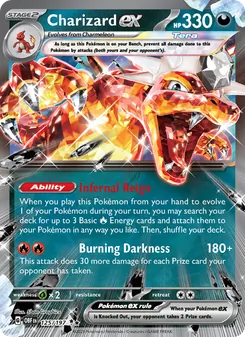
Charizard ex
Obsidian Flames · 125/197
The multiplier is huge, but in absolute dollars it's tiny: a 9 (≈$23) doesn't even cover PSA's cheapest fee, and most NM cards come back 8 or 9, not 10.
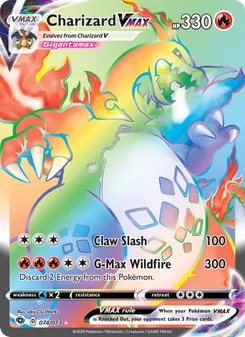
Charizard VMAX (secret)
Champion's Path · 74/73
The 10 only beats the raw by 65%, and a 9 (≈$172) is worth LESS than the raw card. The fee and the risk eat any profit.
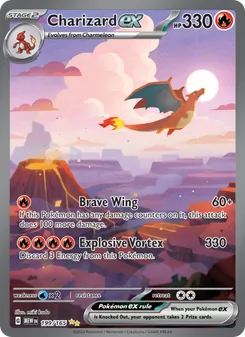
Charizard ex (SIR)
151 · 199/165
A clean asymmetric bet: a 10 quadruples your money and a 9 (≈$347) covers the card and nearly all of the fee. Worth the attempt if the centering and surface look flawless.
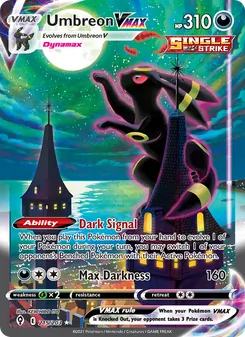
Umbreon VMAX (alt art)
Evolving Skies · 215/203
The famous 'Moonbreon' has a reputation for bad centering, so the 9 is common, and today a 9 (≈$1,878) is worth almost 450 dollars LESS than the raw card. With the 10 premium so thin, the gamble almost never pays off.
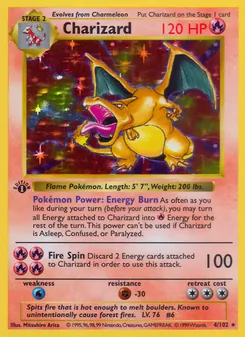
Charizard (holo)
Base Set · 4/102
The 10 is life-changing, but a 1999 card almost never reaches it (centering, print lines). A 9 is worth ≈$3,276. That's why many prefer to pay for a 10 that's already graded rather than risk the raw.
Read the table from top to bottom and you'll see the four scenarios that matter:
The high but deceptive multiplier. The Obsidian Flames Charizard ex is worth about 5 dollars raw and its PSA 10 hovers around 118: a 22x multiplier that looks like a steal. The catch is in the absolute dollars and the risk. A PSA 9 of that card is worth about 23 dollars, and most NM cards come back 8 or 9. If you pay a fee of 17 to 80 dollars for a card whose realistic best case (the 9) is worth 23, you only win if you hit the 10. Grading cheap cards only makes sense in volume, sending dozens in bulk at about 17 dollars a unit and with a very trained eye for the gem rate.
The one that doesn't move the needle. The Champion's Path Charizard VMAX is a sought-after card, hovers around 185 dollars raw, and it's still a clear no. Its PSA 10 (≈305) only beats the raw by 65%, and its PSA 9 (≈172) is worth less than the ungraded card. Add the fee and the risk of the 9 and you'll most likely lose money. A card being expensive doesn't mean grading it pays off.
The clean yes. The 151 Charizard ex (the Special Illustration Rare) is the example of when it does: raw ≈295 dollars, PSA 10 ≈1,200. A 4x multiplier with a beautiful asymmetric bet: if it comes back 10, you quadruple; if it comes back 9 (≈347), you get back the card and nearly all of the fee. When the reasonable worst case is a break-even and the best is 4x, grading makes sense if the card looks flawless.
The six-figure lottery. The Base Set Charizard is the poster child for all this: raw ≈987 dollars, PSA 10 ≈38,600. A 39x multiplier that sounds irresistible. But it's a 1999 card, with centering and print lines that make the 10 extremely rare. A PSA 9 is worth ≈3,276, a tiny fraction of the 10. Sending a raw after that 10 is a low-probability bet, which is why so many people prefer to pay the price of the 10 already made rather than risk their card. The Moonbreon case is similar and even clearer today: a sky-high raw (≈2,325), a thin 10 premium (≈1.5x), a reputation for bad centering and a 9 (≈1,878) that's worth less than the ungraded card. Two very expensive cards that, paradoxically, are poor candidates for grading.
The pattern boils down to one phrase: run the numbers on the 9, not the 10. If the 9 leaves you at a loss and only the 10 saves you, you're buying a lottery ticket, not making an investment.
If you want to see how far the graded market goes on record-breaking cards, take a look at the most expensive Pokémon cards of all time. And if you're not sure what rarity your card is (holo, IR, SIR), the rarity guide clears it up in two minutes: it's the first filter for knowing whether it's even worth running the numbers.
What are your cards worth? Build your collection and track its value live, card by card.
Mistakes and myths that cost you
- "It's old, surely it earns a PSA 10." Age doesn't grade: condition does. A Base Set holo with white corners and crooked centering can come back 6 or 7 and be worth less than selling it raw.
- "It's holographic, it's worth it." The holographic surface is exactly where scratches and lines that tank the grade appear most easily. Vintage holos are among the hardest cards to gem.
- "A 9 is nearly perfect, it'll be worth almost as much as the 10." Almost never. On hot cards, the jump from 9 to 10 is a cliff, not a step: it can be 3x, 10x or more. The 9 resembles the 10 in condition, but not in price.
- "I grade everything expensive." Expensive raw isn't the same as a good candidate. The Moonbreon and the Champion's Path VMAX are expensive and still rarely worth it.
- Forgetting the total cost. The fee is only part of it: add the insured round-trip shipping, the wait of weeks or months and, with PSA, the membership. A 20-dollar card can't carry that math.
How to read a population report at a glance
Each company publishes a population report: how many copies of a specific card it has graded and with what grades. It's public information and, while you shouldn't obsess over it, skimming it helps with two things.
First, calibrating risk: if a card has hundreds of 9s and very few 10s, the gem rate is low and so is your chance of pulling the 10. Second, understanding price: a tiny population of 10s explains why that grade spikes, and a huge population explains why a modern 10 is sometimes worth little more than the raw. You don't need more than that. Look at how many 10s exist versus how many 9s, and you'll have a realistic idea of what you're betting against before you pay the fee.
Who it makes sense for, honestly
Grading isn't for every card or every collector. It makes sense if you have a near-perfect card whose PSA 10 is worth several times the raw and you can accept that it might come back a 9. It makes sense if you send in volume and know how to pick candidates. And it simply makes sense if you like having your favorite pieces sealed and certified, with no thought of reselling: that's a valid reason too, as long as you know you're paying for the pleasure, not for a profit.
It doesn't make sense for cheap cards one at a time, for cards whose 9 already loses money, or for beaten-up vintage holos in the hope that a miracle shows up. When in doubt, the multiplier math and the price of the 9 will almost always tell you the truth.
The best thing you can do before spending a dollar on grading is to know exactly what you have and what it's worth raw today. That's the foundation, in the end, of any sensible decision.
Free tools · Your collection
Before grading, see what you have and what it's worth
Track your collection card by card and its live value in the tracker, to decide with numbers which ones are real grading candidates. Or print free placeholders to save their spot in the binder while you think it over.
About the prices
I separate two kinds of figure on purpose. The raw prices (ungraded) are Near Mint market values from TCGPlayer, updated every 24 hours, and they're the source of the live gallery. The graded prices (PSA 10 and PSA 9) are the median of real eBay sales over the 7 days before the publication date (November 8, 2026), gathered via PokéTrace, and under each card I link a PriceCharting search so you can verify the live graded market yourself. They aren't charted: they're a dated snapshot.
Graded markets are thin and volatile, especially in vintage and in cards in the middle of a frenzy: many figures come from a handful of sales, and record auctions sit alongside much lower normal prices, which is why I give approximate multipliers and not promises. Grading costs change constantly and each company opens or closes tiers depending on how backed up they are, so treat them as guidance and confirm on the official website before sending. All card figures are TCGPlayer USD or eBay only. This is editorial reference, not investment or grading advice.